
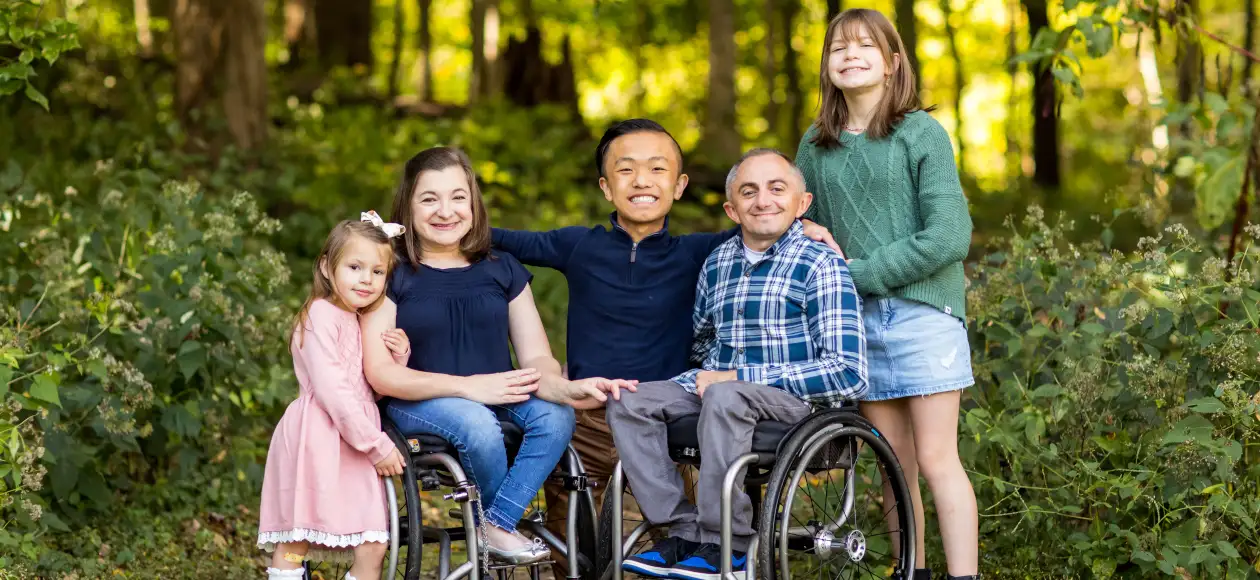
Kids are naturally curious. And when they see differences in people, say, at the grocery store, they may point it out and want to know why. Why is that person in a wheelchair? Why is that boy missing an arm? Why can’t she speak?
As parents, we have a wonderful opportunity to introduce children to discussions about disability. Perhaps not in that moment at the grocery store, but as a larger discussion about diversity and culture within your family.
I am a mom, a psychologist and a person with a disability, and I’d like to share some tips for talking to children about disabilities and helping them value differences in people.
How to Talk to Kids About People with Disabilities
1. Use clear language, like the word disability
Using the word disability is the clearest way to talk about people with disabilities because it is associated with rights, laws and history. It is not a negative word. Further, using words like special needs and differently-abled infer that a person is extremely uncomfortable using the term disability. This, along with avoiding the topic in some situations, could inadvertently send the wrong message that it’s taboo. It’s a normal life for many. In fact, from our data sources at the University of Cincinnati Center for Excellence in Developmental Disabilities, around 1 in 4 children in Ohio have a disability. So, it’s highly likely that your child will encounter a classmate, friend, family member or neighbor with a disability.
2. Highlight shared interests to point out commonalities
As a wheelchair user, children often ask me, “What happened to your legs?” In my case, I was born with my disability so I assure them that nothing happened. But I use a wheelchair to move around. I point out that we’re both able to move around where we want, but we do it slightly differently.
3. Talk in terms of adaptiveness rather than deficits
Sometimes as adults we aren’t exactly sure what a person’s disability might be. That’s ok. We can point out that we’re both going somewhere or doing something. Some disabilities might require different support at school but we all need help learning sometimes. Other disabilities may mean that a child’s actions are unexpected or loud.
4. Use books to guide the conversation
Read books that are positive and focus on a person’s interdependence, which is the idea that we all need help sometimes. The books What Happened To You? and We Move Together are great examples. Steer clear of books that take shortcuts to describe characters as evil by giving them disabling characteristics (eye patches, facial disfigurement). Also, talk through books where we don’t know much about the person, except for how wonderful it is that other children can help the child with a disability. These books have positive intentions but can unintentionally separate kids from understanding that children with disabilities are their peers. They may need help but they also have things to contribute.
5. Recognize that timing matters with public encounters
As parents, we all worry that our kids are going to say or do something that is either embarrassing or inadvertently hurtful. If you’re in public and your child asks a question about a person with a disability, it is ok to say hi to them. But it’s also important to realize that sometimes people with disabilities just want to go about their day. Additionally, some personal questions are more appropriate if/when we get to know someone better. It’s ok for kids to be curious but it’s also ok for people with disabilities to have boundaries.
6. Introduce people with disabilities into your life
One of the best ways we can counter stigma around disability is to be around more people with disabilities. Spot representation of disability in the media. Notice it, talk about it, and celebrate it as a positive step toward an inclusive society. Take your family to a disabled sporting event. Many, like wheelchair football at the Leblond Recreation Center on most Saturday mornings, are integrated. This means that you can hop on a chair and play alongside athletes with disabilities. Connect with disability organizations on social media, such as our University of Cincinnati Center of Excellence in Developmental Disabilities on Twitter and Facebook.
If you’d like to learn more tips for talking to kids about disabilities, listen to this podcast. Drs. Kara Ayers and Susan Wiley, faculty members in our Division of Developmental and Behavioral Pediatrics, share their perspectives for helping kids to be more inclusive, understanding and respectful of their peers who are different than (and similar to) them.


Thanks for this helpful, practical article. So many great ideas. But what WOULD you recommend for that inevitable scene in the grocery store? I think people need a few standard options because it does happen fairly often and how we handle it can make a big difference in how children make sense of disability.At the same time, disabled people are comfortable with their situation and, as you say, eager to get through their day like anyone else. They may or may not welcome an intrusion into their private space. Thanks!
Hi India Jo-Great question. I recommend that parents try to stay calm and neutral. It can be our first reaction to reflect our own discomfort and anxiety about making another person uncomfortable or the sudden attention that our child’s unexpected remark has drawn. We can provide a reasonable answer for them in the moment like, “Oh yes-she’s using a wheelchair to get around.” and then there are some great opportunities to follow up further at home with books and more discussion. Much of the times, kids are very accepting of brief, to-the-point answers.
Kara
Well done! Practical.Real. Kind.So terrific to follow your career. Building on what you already said here…from the perspective of having a sister with disabilities, and parenting a child with disabilities….I was thankful to hear my parents explain my sisters disability ( then I had confidence to talk about it with peers,strangers,too), with Sarah, her personality led the way often in public( says the unbiased mom,lol) but I would like to say it helped to ‘practice ‘ at home some of possible replies to questions in social settings….and also ( while it’s of course not a cure-all) later on to acknowledge there will be stares and it’s a help, sometimes to call it out and ask, hello,do you want to ask me something? Plus the honest acknowledgement, that we too, can give a second or third look at someone who has a different appearance.
Praying for Joy, wisdom in your lovely family!
– Jan
Your blog is really excellent. Through sharing awareness and guidance, you can help people understand and realize that disabilities should not be a hindrance to giving respect and being friends with them. Actually, I know a lot of people with disability that is very creative, talented, and intelligent.