
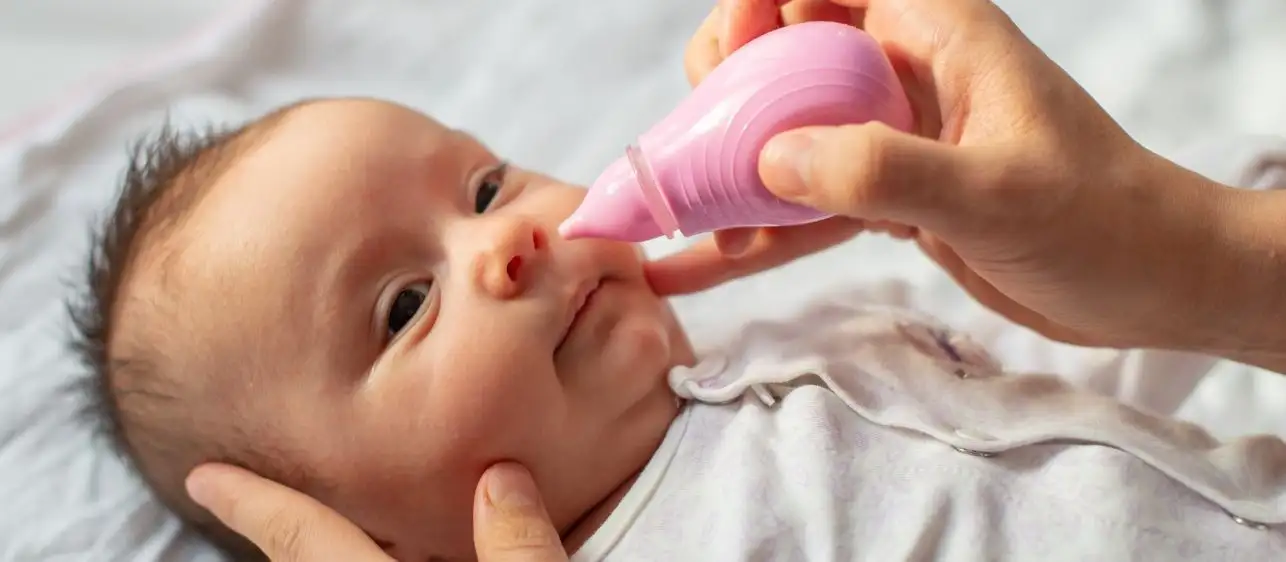
If you’ve had a bulb syringe in your hand and been unsure about putting it up your baby’s nose – you’re not alone! Even though it is a simple tool, it can cause a lot of anxiety for parents.
Concerns about causing discomfort, doing it wrong, or hurting their noses are quite common. But it’s an important skill to learn because babies don’t know how to blow their noses yet.
The good news is that with the right technique, bulb syringes are a safe and effective tool to help them breathe easier. Let’s walk through how to use a bulb syringe and address the most common concerns parents have.
STEPS TO SUCTION BABIES’ NASAL CONGESTION
Bulb syringes are a tried-and-true tool for providing congestion relief to babies. Supplies you will need:
- A bulb syringe: If your baby was born in a hospital, you were likely sent home with one. You can also buy one at a pharmacy or in the baby aisle at the grocery store.
- Nasal saline drops or mist: You can buy these at the pharmacy or grocery store, too.
- Swaddle blanket: If you are suctioning your baby’s nose by yourself, use a swaddle blanket to wrap their arms in the blanket.
Step-by-step guide to use a bulb syringe:
- Lay your baby on their back facing the ceiling.
- Have someone hold their arms or place their arms at their sides and wrap them in a blanket.
- Place 3-4 drops or mist of saline in each nostril and wait one minute.
- Use your thumb to push the air out of the bulb syringe.
- Place the tip into the nostril until the nostril is sealed.
- Let the air back into the bulb by slowly removing your thumb. This will pull the mucus out of the nose and into the bulb.
- Remove the bulb and squeeze the mucus onto a tissue or paper towel.
- Repeat the steps in the other nostril. You may need to repeat several times on each side.
- Wipe your baby’s nose with a tissue when finished to prevent the skin from getting irritated.
- Clean the bulb syringe in warm, soapy water after each use.
Once you have done it a few times you will start feeling more confident! However, I would like to address some common concerns to help put your mind at ease:
CONCERN #1: SWELLING, IRRITATION, NOSE BLEEDS
Parents worry that suctioning too much or too hard might cause swelling, irritation and/or nose bleeds.
Helpful tip:
- Place 3-4 drops of saline in each nostril, then wait a minute before suctioning. This will help loosen mucus and make it easier to suction.
- Suction up to four times a day. This is about how often their little noses can tolerate it.
CONCERN #2: VOMITING, CHOKING, GAGGING
Some parents are concerned that suctioning will cause their baby to vomit, choke or gag during nasal suctioning. This isn’t common. However, it is common for babies to vomit from choking on excess mucus. Bulb suctioning is the best way to get that mucus out and provide relief.
Helpful tip: Suctioning before eating and sleeping will help them do these activities more easily.
CONCERN #3: PUSHING MUCUS DEEPER
Some parents are afraid that putting the bulb syringe into their baby’s nose will push the mucus deeper into the sinuses.
Helpful tip: When used appropriately, the syringe should not push mucus deeper. Squeeze the air out of the bulb before placing the tip in your baby’s nostril. Then release the bulb. The tip does not need to go in far!
CONCERN #4: INFECTIONS
We’ve heard that parents worry about germs staying on the syringe and then those germs going back into their little noses.
Avoid by: Cleaning the bulb syringe with warm, soapy water after each use. Squeeze soapy water into and out of the syringe and then let it air dry. This should prevent mold and mildew from building up inside the bulb.
CONCERN #5: A FUSSY BABY WILL BECOME EVEN MORE FUSSY
This is valid – your baby will likely fuss during suctioning. None of us like having things in our noses, but they will breathe easier afterwards. If they could thank you, they would!
Helpful tip: If you have the luxury, use two people to do the suctioning. Have one person hold the head and arms and the other use the bulb syringe. While it won’t stop the fussing, it will go faster when your baby’s head is still and their arms aren’t in the way.
CONCERN #6: THE OTHER TOOLS TRANSFER GERMS
There are other suctioning tools that require the parent to suction the mucus out using a straw-like device. Some parents think that this is gross and that it transfers germs – but it doesn’t! It is safe for both parents and babies.
Helpful info: There are also battery powered and electric suctioning devices. These can also be effective, and parents should use whichever tool they’re most comfortable with!
If you have additional questions, or would like to speak with a pediatrician in our Division of General and Community Pediatrics, please call 513-636-4506.