
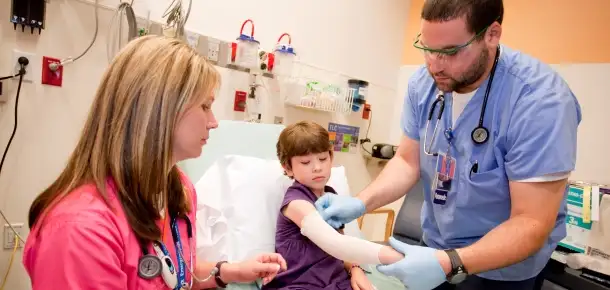
URGENT CARE OR EMERGENCY ROOM?
Children with serious or life-threatening injuries or illnesses should be taken to the Emergency Room.
If your child’s injury or illness is not life-threatening, but needs attention quickly and your pediatrician’s office is closed, Urgent Care is most likely the place to go.
MORE ON URGENT CARE CENTERS
It is helpful to remember that going to Urgent Care is similar to your physician’s office, with a few added services. Please keep in mind that Urgent Care is not the ER and is not staffed for life-threatening emergencies.
Here are some of the most common things we examine and treat at Urgent Care:
- Simple lacerations and wounds
- Fractures and injuries to arms, legs, fingers and toes
- Ear aches, runny noses, cough and fevers
- Common pediatric illnesses such as mild asthma attacks (cough and mild wheezing), stomach flu, diarrhea, vomiting, rashes and strep throat
- Minor burns
Cincinnati Children’s has five Urgent Care locations:
You can check current estimated wait times at all of our Urgent Care centers online.
If you bring your child to one of our urgent care centers and our physician feels your child needs to go to the Emergency Department, a transport team will be called so medically trained professionals can accompany you and your child to our main hospital.
MORE ON EMERGENCY ROOMS
Life-threatening emergencies should be handled in the Emergency Room (ER), and a call to 911 is the best way to get there. Please don’t try to take your child to the ER yourself.
Life-threatening emergencies include:
- Breathing difficulties (including severe asthma attacks where the child is wheezing too much to count to ten or a baby is wheezing too much to drink or nurse)
- Severe trauma
- Seizures
- Allergic reactions
- Head or neck injuries
- Uncontrollable bleeding
- Broken bone, if bone is sticking our of skin
- Severe burns
Cincinnati Children’s has two full-service ERs:
CONTACT YOUR DOCTOR FIRST
If you feel your child needs to be seen by a doctor, it is always best to call your child’s primary care physician first; he or she will direct you to the appropriate level of care. If you feel like you don’t have time to wait for a call-back from the physician on call, you should call 911 for help and a ride to the ER.
For more information on where to take your child, or to find urgent care centers and emergency rooms in your area, u003ca href=u0022https://www.cincinnatichildrens.org/patients/visit/directions/urgent-care/careu0022u003evisit our websiteu003c/au003e.




Dr (Captain) Orcutt!
Hello again!
I worked with you at WPAFB.
I went around the world and ended up at CCHMC myself. After 17 yrs in the ER trenches, I’ve gone to the world of NICU, so I doubt I’ll get to see you in person. (yes still working nights :-)) I do miss the ER some days.
Heidi Staub, Capt (sep) USAF
urgent care physicians are often the best choice for most healthcare needs. Not only do they have a personal relationship with your child, but they know your child’s medical history, including allergies, vaccinations and recent illnesses. However, it can be difficult to see your doctor on short notice or after-hours… and some medical issues need immediate attention.
Thank you, this is extremely well-written! Very good information to keep on hand.
Thanks for sharing this advice on choosing between urgent care and the emergency room for different injuries. I agree that it is probably a good idea to go to an urgent care center when the injury needs to be looked at immediately, but isn’t life altering. However, more serious issues like a serious chronic illness should definitely warrant a trip the ER. However, the level of care at emergency medical centers can vary from place to place.
When it comes to having to go to hospital, it is actually a good idea to know how to differentiate. I like how you have tips to determine if something is an ER emergency or Urgent Care emergency. I will definitely want to pass this on to my friends who have kids as well so that way they can have peace of mind. https://www.tricitymedical.net
As a parents, we all worry about our children and want to provide them with the best care. Sometimes it is hard to know where to take them for this care, but this post helps me know the best option. I really like that this has specific lists for the ER and urgent care center, so there doesn’t need to be any question of what to do. Thanks so much for sharing this.
I think a good way to know if our child should go to the emergency room is, as you mentioned, if they are in a life-threatening emergency. Like June said in her comment, as parents we all worry about our children. I want my son to be healthy and taken care of. We had to go to the emergency room once when he was younger. Everything was taken care of perfectly and we were so glad we took him to the emergency room, he received the right care because of it. Thanks for your really helpful article on taking care of our kids.
[…] you need a refresher on when to take your child to the Emergency Department versus Urgent Care, this link provides […]
In a moment of emergency, it’s always important to know what action to take. Understanding when to go to urgent care is part of that. I have three little boys, and I want to make sure I am prepared for any emergency. I didn’t realize that strep throat could be treated at an urgent care, but that’s nice to know. Thanks for sharing!
I had a hard time distinguishing where to take my son when he was really young and would often get sick. Many times I would just take him to the emergency room because it was so close to my house. They usually took a lot better care of him in the ER but many times it wasn’t completely necessary to go to there. It helped to have good insurance at the time because he got sick so often! I think this article is great with distinguishing whether to take a child to the ER or urgent care.
It really can help to figure out when you should be taking your child to an urgent care center or an emergency room. After all, you will want to make sure that they are receiving the best and most appropriate care possible.
It really is important for patients to learn which afflictions can be treated by the staff at an urgent care facility and which ones cannot. I particularly like that you bring up fractures as something that an urgent care center can address. After all, most people would just immediately assume that they need to go to the emergency room, so it helps to know that they have options.