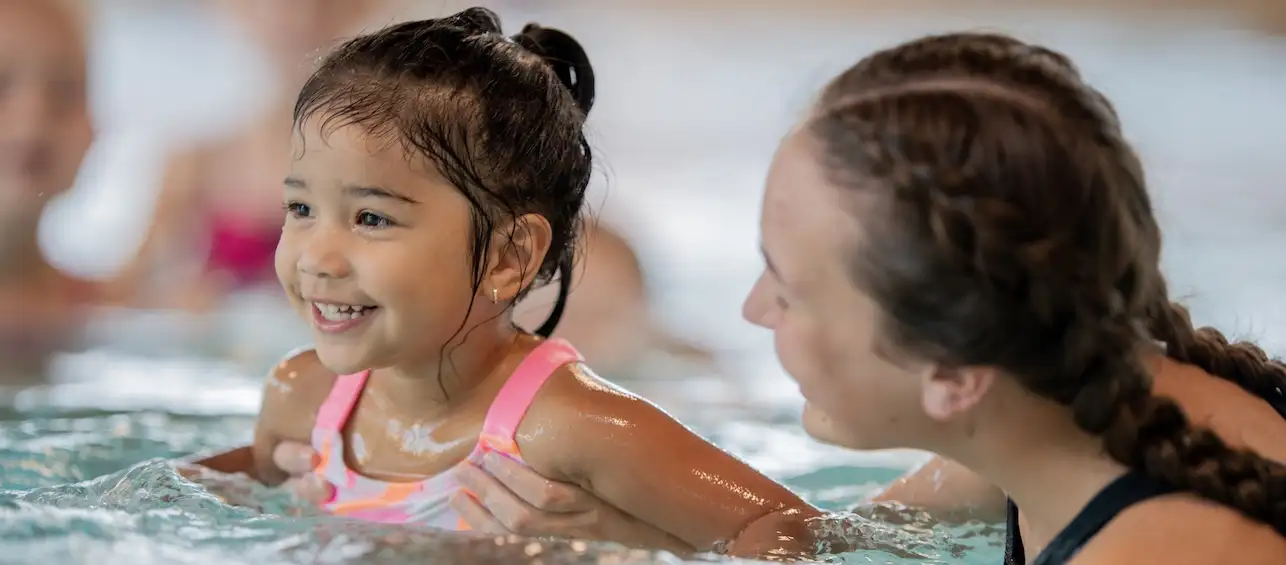
In kids ages 1 to 4, swim lessons can reduce drowning risk by up to 88%. In 5- to 19-year-olds, it’s 64%. Those are powerful numbers, and a good reason to start your child in swimming lessons no matter what age they are.
Swimming lessons are generally recommended for kids over age 1. Most kids will be ready to learn to swim between ages 1 and 4.
Readiness for swim lessons depends on the development of the child, both emotionally and physically. Kids who have some motor delays might be on the later end of that age range. Kids who are a little more advanced in their development might be closer to age 1.
If you’re not sure if your child is ready for swim lessons, talk to your pediatrician.
5 Things to Know When Looking Into Swim Lessons
A person with basic swim skills should be able to:
- Get into the water on their own and come up to the surface.
- Turn around in the water.
- Swim 25 yards.
- Be able to float in or tread water and then get out of the water on their own.
Here are 5 things parents should be aware of when considering swim lessons for anyone in the family.
1. Know that it’s never too late to learn how to swim.
Swim lessons are not only for young kids. Water skills are important and can be learned at any age. Even adults or seniors who don’t know how to swim can learn. Classes are available for all ages, and family lessons are also an option.
2. Know how to help kids who are afraid of the water.
Early exposure to the water helps to prevent fear of water from developing. One great option for this early exposure is parent-child classes. These are most often offered for the toddler age range. They’re designed not to teach basic swim skills, but really to teach comfort in the water and readiness to be in the water and learn skills.
The earlier you can get your child in the water, the better. If your child is really uncomfortable, try looking for one-on-one classes where there is one teacher with your child alone. This allows your child to go at their own pace, and may help ease discomfort they might feel around other kids.
3. Know the facts about infant water survival classes.
The American Academy of Pediatrics does not recommend infant water survival classes. The targeted age range of these classes is children less than 1 year old. Most kids in that age range don’t have enough head control and motor tone to be able to lift their head out of the water to breathe. There’s no evidence to show that these classes reduce drownings.
4. Know what to look for in swimming lessons.
When researching swim lessons for your child, look for the following:
- Qualified instructors. The swim instructors should have certifications showing they have taken courses on how to teach swim lessons. If the pool also has lifeguards on duty, that added layer of supervision is a benefit.
- A program that teaches water safety habits. Examples of good water safety habits include no running on the pool deck, and having children sit on the side of the pool deck but not enter the water until they’ve asked for permission.
- Multiple lessons. Swimming is best learned over multiple lessons with skill assessments that measure progress. You’ll want to see specific plans of what outcome is expected at each level of learning.
- A good environment. Things to look for include positive interactions between the teachers and students, warm and clean water, and rules around diapered children in the pool and appropriate swimwear.
Another important consideration for kids ages 4 and under is touch supervision, where the instructor remains in the water and within arm’s reach of every child. - Fundamental swim safety skills. Look for a program that teaches kids safety skills such as how to float, tread water, and get in and out of the pool.
5. Know about drowning risks.
It’s important to understand that swim lessons don’t equal drowning prevention. While lessons might reduce a child’s risk of drowning, kids who have had swim lessons can still drown. Factors like environment, the temperature of the water, and weather all can play a role in a drowning event.
It’s still crucial to make sure your child is watched in the water. No person should ever swim alone.
To help your family be as safe as possible while swimming, follow these water safety precautions any time your child is near water.