
Because I was born with double outlet right ventricle, a type of congenital heart defect, along with additional heart conditions, I never thought that it would be possible for me to carry a child. In fact, for most of my life I was told that pregnancy probably wasn’t a good idea.
However, at my annual heart check through the Adult Congenital Heart Disease (ACHD) Program at Cincinnati Children’s in 2012, my husband and I asked my congenital heart specialist if pregnancy with ACHD was possible for me.
His response gave us a lot of hope. He said that it is possible for women with congenital heart defects to have healthy pregnancies — so long as our hearts are in the best condition possible beforehand and we’re followed closely during pregnancy, delivery and postpartum.
Even after learning this, I was still skeptical. Suddenly, what I thought was impossible became possible. I had dreamed of having my own children, but it was hard for me to wrap my mind around the possibility after being discouraged from it for so long. I wanted to do my due diligence.
My doctor explained that they would run all of the necessary tests to make sure that my body could handle pregnancy, delivery and beyond. My biggest fear wasn’t the pregnancy or even delivery. Maybe I had seen the movie Steel Magnolias too many times, but I was afraid that my heart would give out a few weeks or months after delivery. I needed to feel 100% certain that this wouldn’t happen to me.
After about a year of testing (EKGs, stress tests, echocardiograms, physical exams) and a discussion about genetics and family history, I was given the green light. My cardiologists were confident that my heart could handle all aspects of pregnancy and beyond.
As a last step and before becoming pregnant, I wanted to speak with the obstetricians who work directly with the ACHD Program to make sure that they were in agreement as well. My husband Zach and I went to meet with a maternal-fetal medicine (MFM) specialist to discuss all aspects of my future pregnancy. He also felt confident about my safety and my ability to carry a baby.
So even though I had received two green lights, I still had mixed feelings. On the one hand, I was elated — I had both my cardiologists and a high-risk obstetrician confidently telling me that my body could handle pregnancy. But on the other hand, I was scared. I had the “what-ifs” rolling through my head. The group of doctors sitting around the table told me that the probability of those what-ifs happening were extremely unlikely — and even if they did happen, they had a plan in place. And I was reassured that they would be monitoring me every step of the way. I think that’s what I needed to hear.
So fast forward to December 2014 — I became pregnant and my dream was beginning to become reality! For nine months I was closely followed by a care team consisting of a maternal-fetal medicine specialist, an ACHD specialist, and a maternal cardiac care specialist. Through this program, Zach and I met with both my OB and my cardiologists at Cincinnati Children’s in the same room once a month. As a group, we discussed the progress of the pregnancy, contingency planning for possible complications, and expectations at delivery and postpartum to ensure my pregnancy went smoothly.
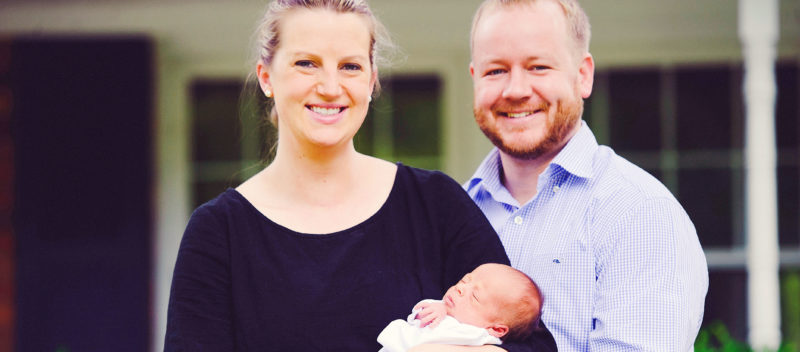
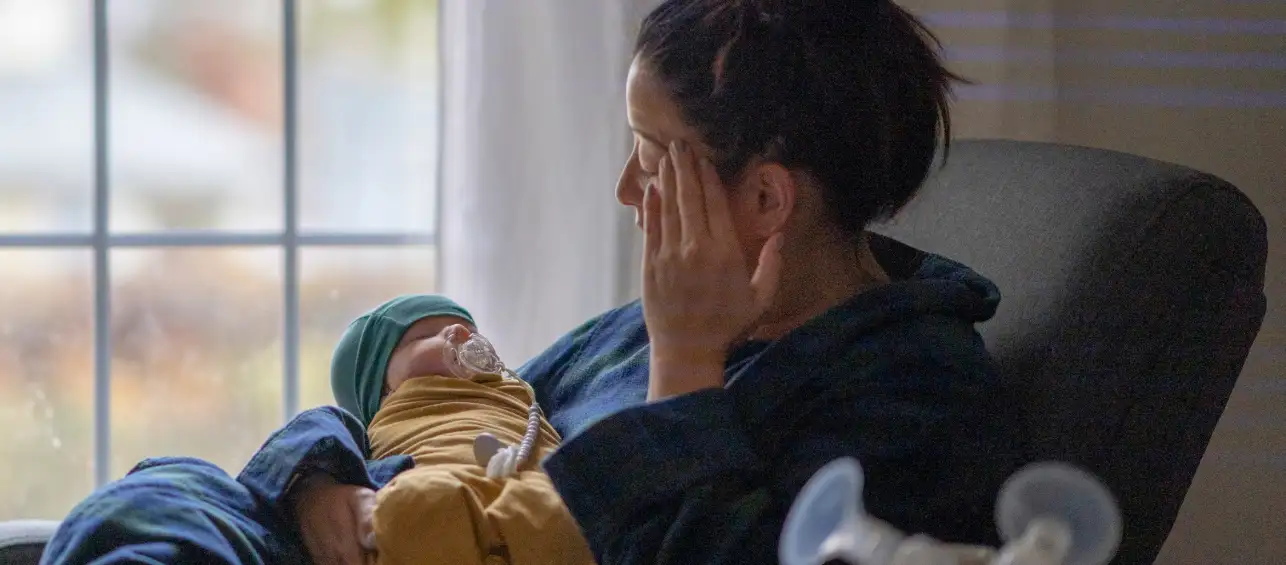
It did, and on September 1, 2015, Annabelle was born. She has my spunk, her dad’s dimples, and most importantly — she doesn’t have my heart def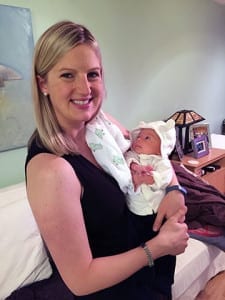 ect, which we confirmed at 20 weeks during a regularly planned fetal echocardiogram. We were ecstatic that she was perfectly healthy when she was born. She had rosy cheeks — as opposed to them being blue, which can sometimes happen when babies are born with a heart defect — and a healthy set of lungs, which she demonstrated quickly!
A few hours later, as my husband and I reflected on the beautiful moment of our daughter’s birth, and bonded with Annabelle, my MFM specialist stopped by to check on us. He brought us an additional gift…another green light. He said that my body had not only tolerated the pregnancy well but the delivery too. So much, in fact, that he feels confident my body could tolerate pregnancy again.
What an amazing feeling. I had my newborn daughter in my arms, a green light to have another baby in the future, and justification that we made the right choice to embark upon this journey.
Editor’s note: The Adult Congenital Heart Disease team at Cincinnati Children’s partners with colleagues at TriHealth and the University of Cincinnati Medical Center. Both programs use teams of specialists in maternal-fetal medicine, cardiology, anesthesia and cardiac surgery. Women with congenital heart disease who are considering pregnancy are encouraged to seek guidance before pregnancy. For more information, please contact our ACHD Program at 513-803-2243.
Thank you for this! I too have a congenital heart defect (tricuspid atresia) and was always told it wasn’t possible growing up. 2013 we asked again, and was told differently! We were blessed with our miracle March of 2014 – and she also does NOT have any heart defects!
Everything went smoothly throughout the pregnancy, but I had a massive pulmonary embolism 2 weeks after she was born and had to have emergency open-chest surgery (again) to remove it. It was rough, but God is good. People tend to ask if I question our decision to “risk” having our little one, but I don’t for a second.
Thank you for sharing!
Reading this really gives me hope that, maybe some day I may also be able to tolerate pregnancy. As like any other, being born with a CHD is stopping me to go with my gut feeling, despite of red signals from various doctors.
I have the exact same defect as you and you are giving me such hope! My husband and I want to start our family and I have been so terrified and unsure and reading your story really made me so excited. I too am from Ohio and love your story.